Saturday, November 24, 2018

Gaia DR2: Milky Way Open Clusters

Gaia's Data Release 2 provides improved positions for more than 1 billion (10^9) stars. The paper "A Gaia DR2 view of the open cluster population in the Milky Way." by T. Cantat-Gaudin, et al. (2018) uses that information to generate a catalog of more than 1,000 Open Clusters and about 400,000 of their member stars.

I've created an Addon for Celestia v1.6.1 and later, A93, which uses that paper's published catalog to provide the locations of 1,229 Open Clusters and 397,897 stars. It's available as https://www.classe.cornell.edu/seb/celestia/files/A93_open_clusters.zip (20MB, expands to 25MB).

Here's the Pleiades Cluster viewed from near the Earth.


Photo:

Wednesday, November 7, 2018


A revised version of Celestia's default stars.dat, containing 114357 stars, is available at https://www.classe.cornell.edu/~seb/celestia/files/simbad-hipparcos_v114.zip  (about 1.9 MB, expands to  2.2 MB).

The star positions were obtained from the Simbad astronomical database, which uses Gaia DR2 positions for most of its stars. Simbad is available at http://simbad.u-strasbg.fr/simbad/. For details about Gaia, see http://sci.esa.int/gaia/

Thursday, August 17, 2017

Interstellar travel routes

In many SF settings, one would like to see the routes used to travel between stars. Celestia's "Asterisms" feature can be used to draw lines between stars, but it has limitations. All of the lines are the same color, for example.

nroutes.celx is a Celestia script which creates a .CMOD model of lines, each drawn between any pair of Celestia objects, any color you want, and with their visibility potentially controllable by a Visibility setting.

https://www.classe.cornell.edu/~seb/celestia/files/nroutes.zip

(9KB expands to 15KB)

See its accompanying readme file for usage details.

Briefly, nroutes.celx reads a .csv file, each line (row) of which defines a separate route. You don't have to specify the RA, Dec and distances of their endpoints yourself, instead you specify object names which are known to Celestia. The script extracts their (cartesian ecliptic) coordinates from Celestia and uses those values to create a .cmod model file.

For example, one of the lines (rows) in the the .csv file used to specify a route between Alpha Centauri and Sirius could look like this:

ALF Cen,Sirius,1.0,1.0,0.0, alpha cen to sirius


The first two fields are the names of two Celestia objects which are the endpoints of the line. They can be any of the synonyms known to Celestia for any of its STC or DSC objects. The three numeric fields specify R, G and B values used to color the route line. The text following the 5th comma is ignored.

(In principle one could specify SSC object names, but they change position and the CMOD lines don't.)

The structure of the .csv is rather restrictive (e.g. no embedded blank lines or comment lines) but the script does not try to verify that you've entered the correct names or used the right line format. Either the script or Celestia will crash or the CMOD won't be drawn if the data is too badly messed up. In principle a lot of error detection could be added, but I just didn't feel like spending the time on it. Maybe some future version could do that. Or maybe someone else could make the appropriate changes to the script.


Interactive maps

Ilanthar of the Cartographers Guild has been posting some beautiful maps of his Resurgence stellar system in the threads https://www.cartographersguild.com/showthread.php?t=38300 and https://www.cartographersguild.com/showthread.php?t=38449

Although the maps that he's published have been static images, they give the impression that they're screengrabs from an interactive information display system. With his permission, I've started implementing a simplified version of that system, using Celestia as the platform.

Several Celestia Addons which add interactive features to his maps are now available on the Web at https://www.classe.cornell.edu/~seb/celestia/resurgence/

Here are a few screengrabs:


Sunday, July 2, 2017

Large Catalogs

Over the past few months I've been struggling with large star and galaxy catalogs, ones which typically include information for about 2 million objects. Here are some of my results.


Galaxies: SDSS DR13

 sdss_dr13_galaxies.zip (v0.9; 30MB expands to 37MB, 06Jun17)

This Addon provides views into the distribution of galaxies in the depths of space. 

Although their database of galaxies hasn't undergone significant modifications for several data releases, I extracted galaxy positions and Z values from the Sloan Digital Sky Survey's 13th Data Release to create this Celestia Addon.

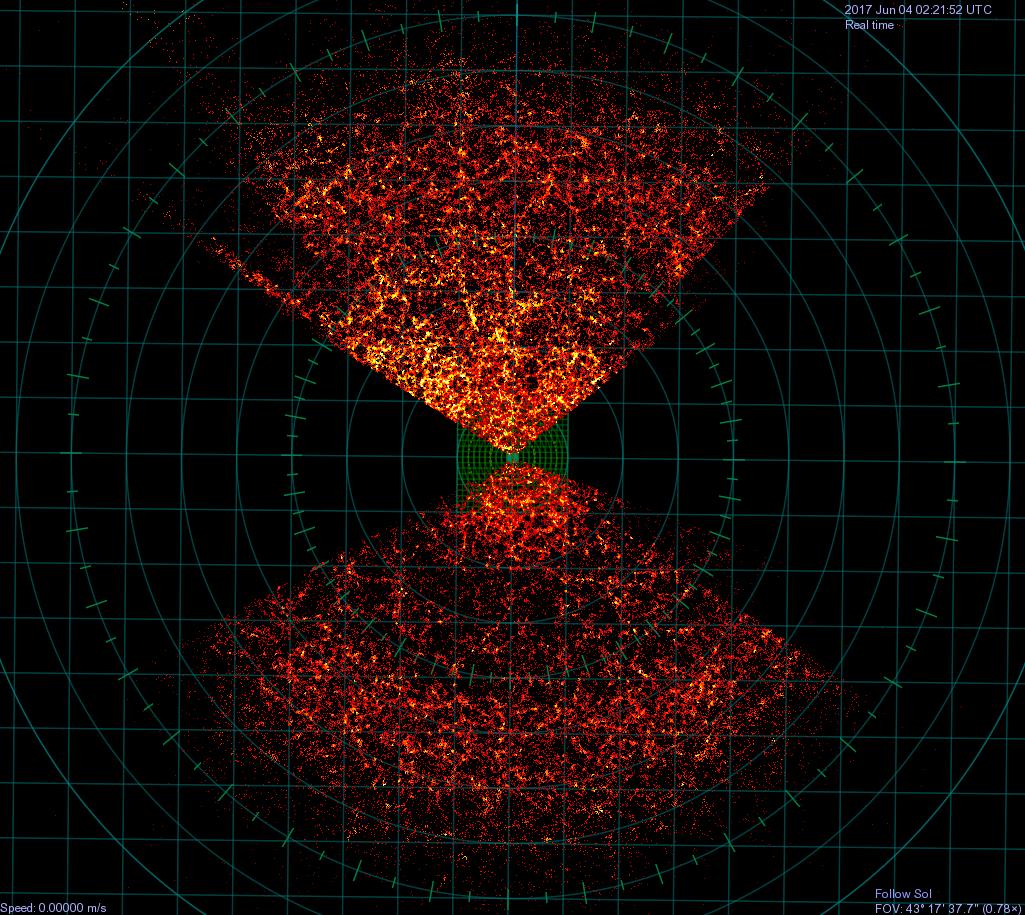
This first image shows Celestia displaying an equivalent of the SDSS Orange Pie image. (The original can be seen at http://www.sdss.org/science/orangepie/) It shows the positions of about 200,000 galaxies in a relatively thin layer, with Equatorial Declinations of +/- 1.5 degrees. Each dot representing a galaxy is colored proportionally to the local density of galaxies: red for low densities, through yellow, to white for the highest density.


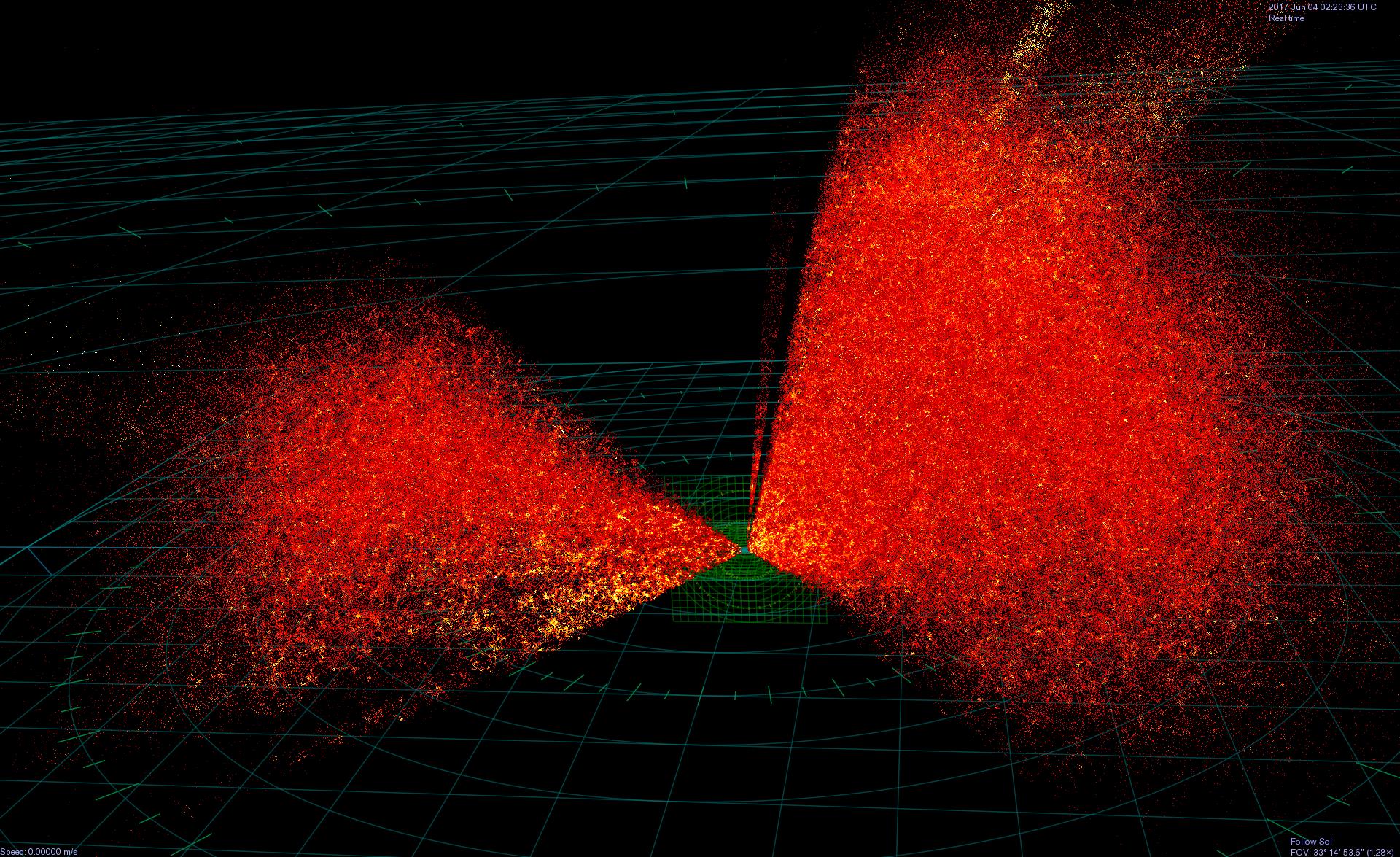
This second picture below shows approximately 2,000,000 galaxies.  Their conical  distributions are due to the limited regions of the sky in which the SDSS has done their measurements. For example, they avoid the regions of the sky obscured behind the stars and dust clouds of our own Milky Way galaxy.


These and other views are available in the Addon.


 Open Clusters

gaia_clusters_v2.zip (7.9 MB, expands to 10.3 MB, 14Jun17)

This Addon for Celestia v1.6.1 displays the positions of stars which are likely to be members of various open clusters. It includes a star database derived from Gaia DR1, defining the locations of 416,945 stars with parallax errors less than 10% of their parallax values. It also includes all-sky plots showing the relative coverage of Tycho-2, TGAS and this Addon's star databases.


Bright Stars

 OB_Stars.zip (404KB, expands to 2.8MB 04May17)

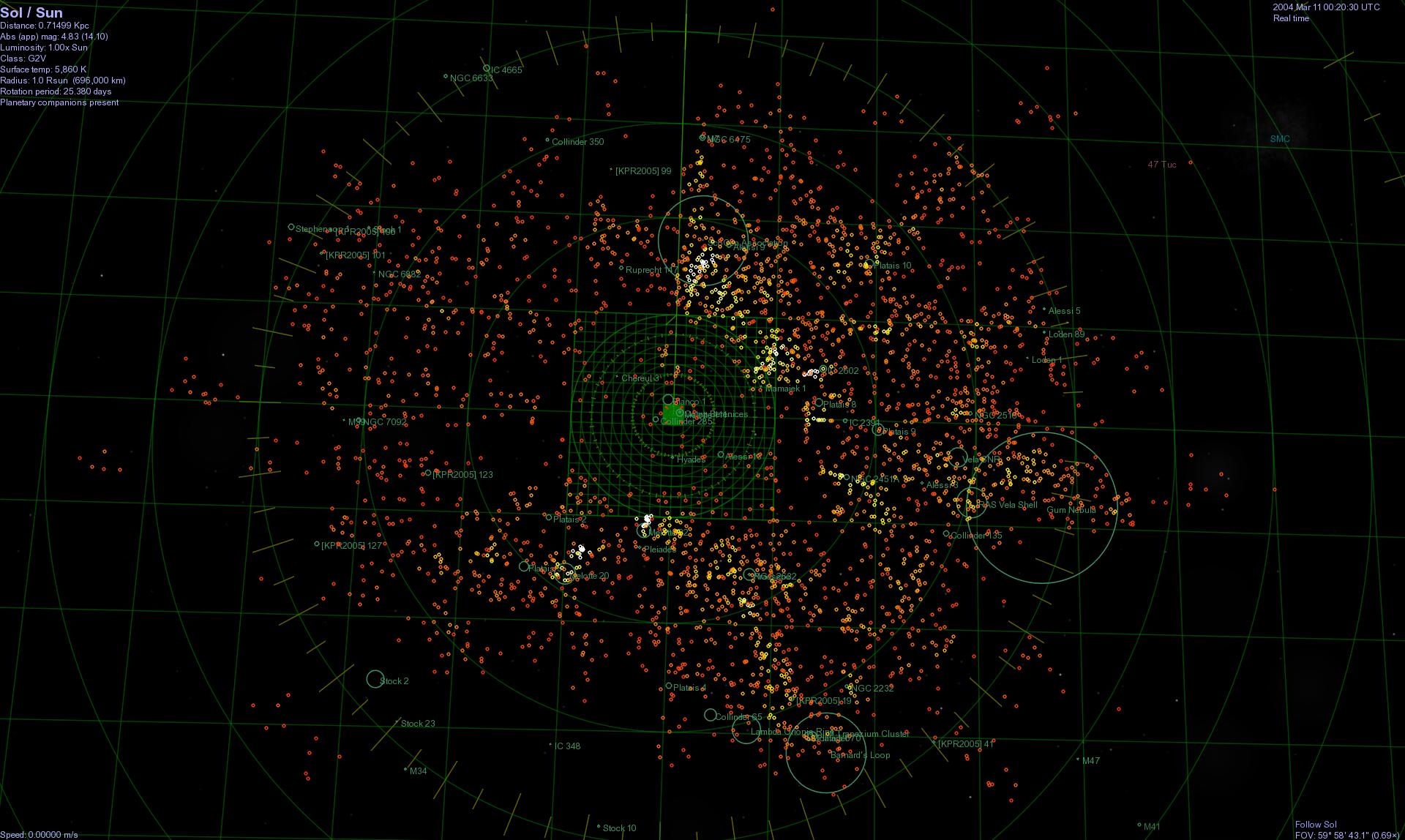
This Addon lets you display the density of the clouds of B stars within about 1500 LY. The colors of the marks vary from red (low density) through yellow (medium density) to white (high density).


If you squint, you can see a trail of bright marks (high star density) leading from our Sun down to the Orion Nebula, which is at the lower right. Toward the upper right you'll see vast OB Associations of young stars.


Thursday, September 29, 2016

Gaia star catalog for Celestia

The ESA's Gaia astrometric satellite has published its first Data Release, providing RA, Dec and parallax measurements for about 80% of the more than 2 million stars of the Hipparcos Tyco2 catalog. They provide RA and and Dec for another 2 billion or so stars, but they can't be used in Celestia without parallax measurements (distances). An updated DR2 is expected to be available in spring of 2018. For details, see http://sci.esa.int/gaia/

Although a 2 million star database is already available as an Addon for Celestia, most of its distances were derived using spectrographic and magnitude information and not a direct parallax measurement. As a result, they're relatively unreliable.

A revised version of Celestia's default stars.dat, containing about 110,000 stars, is available at https://www.classe.cornell.edu/~seb/celestia/files/gaia_stardb.zip  (about 2.75 MB, expands to  5.4 MB)

Revised versions of Pascal Hartmann's stars.dat containing 1 or 2 million stars are available at https://www.classe.cornell.edu/~seb/celestia/files/gaia_1_2m.zip  (about 51 MB, expands to about 59 MB)

Approximately 2/3 of the stars in each of those three stars.dat files have been updated with Gaia's distance measurements.

Interactive notebook: a WIP

I'm in the process of constructing an interactive notebook for use in Celestia, using Anim8or to design its components. It's interactive in the sense that the viewer can turn its pages, not that new entries can be written from within Celestia. Writing on a page has to be done "out of band" by painting the surface texture for each leaf of the notebook.

A sub-project was to create what looks like a taped-in photograph which will be used in several places. I have made it available on DeviantArt at http://celestiaguru.deviantart.com/art/Photo-03-taped-instant-photo-636917231


Sunday, July 31, 2016

Orion's Arm Wormholes

As another distraction, I've been working on a Celestia Addon which displays the wormhole connections used in the Orion's Arm Universe


Saturday, July 30, 2016

New Celestia Web site and Forum

With permission from Chris Laurel, the official Celestia Web site has been transferred to http://celestiaproject.net/

The new site is being run by a Celestia enthusiast in Russia and includes a Web Forum at http://celestiaproject.net/forum/

Monday, July 11, 2016

Algae and Fish Farming

Production of basic foods in space require plenty of sunlight as well as some gravity. While the plants and animals might not mind microgravity, production facilities work better when there's something pulling the product in particular directions. The toruses counter-rotate in order to minimize torques on the docking facilities.


Monday, July 4, 2016

ECS-5 Norway at Pell

Using Troutweaver's models, I've created a very preliminary and incomplete animation of the warship ECS-5 Norway entering the Pell system. It's about 98 seconds long. The original video is 1024x768.  By default, Youtube shows it at a much lower resolution, but if your browser has a video downloader plugin, you can download it at its full size.

 The video can be seen at
ECS-5 Norway at Pell (on Youtube)

 Here's a teaser screengrab:


Sunday, June 26, 2016

Loading a Can Hauler

After a bit of struggling and letting my subconscious work on it overnight, here's an animation of a can being loaded into the hauler.

The models of the "hero" can and of the ships were created by Troutweaver.

I created the "depot" where the cans are stored while waiting for transshipment and a simplified can design to reduce graphics overhead.

The 640x480 video can be watched at
https://www.youtube.com/watch?v=vYwbla8zp08

Tuesday, June 21, 2016

Loading a Can Hauler

Troutweaver was kind enough to send me a few more of his models.

Here's a Can Hauler being loaded. This is a "diorama". The models (cans, pusher and hauler) are being drawn by Celestia in fixed relationships with one another. I might be able to make it more active with the pusher actually shoving cans around, but that'll take some work.

 I think the pilot of the pusher is going to catch hell from the can hauler's cargomaster. The cans are being loaded in the wrong order: they should be loaded around the circumference starting close to the engines. That way the can hauler can leave with only a partial load and not be off balance.

(I didn't think of that problem until after I'd written the "catalog" for Celestia. Changing it would be enough work that I don't feel like doing that just yet.)


Monday, June 20, 2016

Mirrors reflecting sunlight into the torus.

NASA needed a little funding help....


Saturday, June 18, 2016

DSV Ringmaster

Here's another preliminary model, this time of the U.S. manned spacecraft sent to explore the Saturnian system in John Varley's book Titan. (See my previous posts.)


Thursday, June 16, 2016

Cables

Gaea has a multitude of cables supporting its structure, similar to a suspension bridge. Here's a preliminary layout as seen from inside the torus. It's incomplete and incorrect, of course.


Friday, June 10, 2016

A new project: Celestia Addon for Troutweaver's models

Something a little simpler, since I don't have to make the models myself. Troutweaver's models need only a few minor tweaks, like resizing so Anim8or likes working with them and reorienting so rotations work appropriately. Here's an initial attempt, showing two of his models, Norway and Pell Station, as drawn by Celestia.


Tuesday, June 7, 2016

Bent, poked and stretched

It took me a while to find the scale and offset needed to persuade Anim8or's "bend" Modifier to torque a straight tube the appropriate 60 degrees. I'd made a tube with its length the same as 1/6 of the circumference of the desired torus, but most offsets for the bend Modifier kept stretching its outside circumference instead of leaving it unchanged.

Then there's the matter of keeping the spoke from being squished during the bending. Pre-stretching left it all lumpy. :(  I had to cut it off and then reattach it afterward. I think it's a little skinnier than it should be, but I'm not up to resizing it for now.

Celestia has a bug in how it draws transparent surfaces when they're regions of an single mesh which have had a transparent material applied to them: their surfaces aren't correctly depth-sorted. The workaround is relatively straightforward, though: cut them out and paste them into the mesh but leave them as separate objects.


Saturday, June 4, 2016

Drawing Gaea


Infrequent posts are infrequent. :)

I've decided to try to model Gaea, a toroidal alien described by John Varley in his Gaean trilogy: Titan, Wizard and Demon. Some help with getting the sizes of its components correct was provided by someone who'd modeled it previously. In the Celestia screen-grabs below, individual components are separate meshes and have different colors. This is to help verify that the sizes are appropriate. In the final version, each 60 degree segment of the torus will be a single mesh, prodded into the appropriate shape. (Note that its mirrors are omitted for now.)

Using a rectilinear segment:


With the segment bent 60 degrees: