Sunday, July 2, 2017

Large Catalogs

Over the past few months I've been struggling with large star and galaxy catalogs, ones which typically include information for about 2 million objects. Here are some of my results.


Galaxies: SDSS DR13

 sdss_dr13_galaxies.zip (v0.9; 30MB expands to 37MB, 06Jun17)

This Addon provides views into the distribution of galaxies in the depths of space. 

Although their database of galaxies hasn't undergone significant modifications for several data releases, I extracted galaxy positions and Z values from the Sloan Digital Sky Survey's 13th Data Release to create this Celestia Addon.

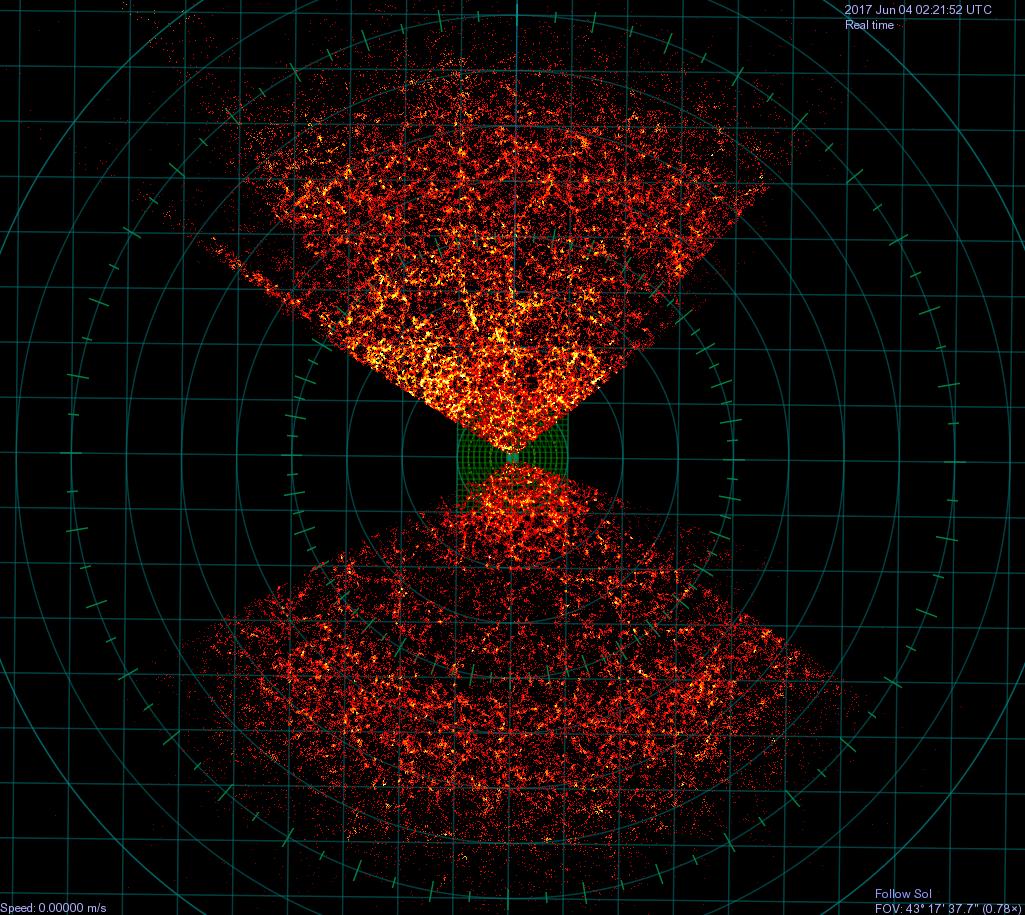
This first image shows Celestia displaying an equivalent of the SDSS Orange Pie image. (The original can be seen at http://www.sdss.org/science/orangepie/) It shows the positions of about 200,000 galaxies in a relatively thin layer, with Equatorial Declinations of +/- 1.5 degrees. Each dot representing a galaxy is colored proportionally to the local density of galaxies: red for low densities, through yellow, to white for the highest density.


This second picture below shows approximately 2,000,000 galaxies.  Their conical  distributions are due to the limited regions of the sky in which the SDSS has done their measurements. For example, they avoid the regions of the sky obscured behind the stars and dust clouds of our own Milky Way galaxy.
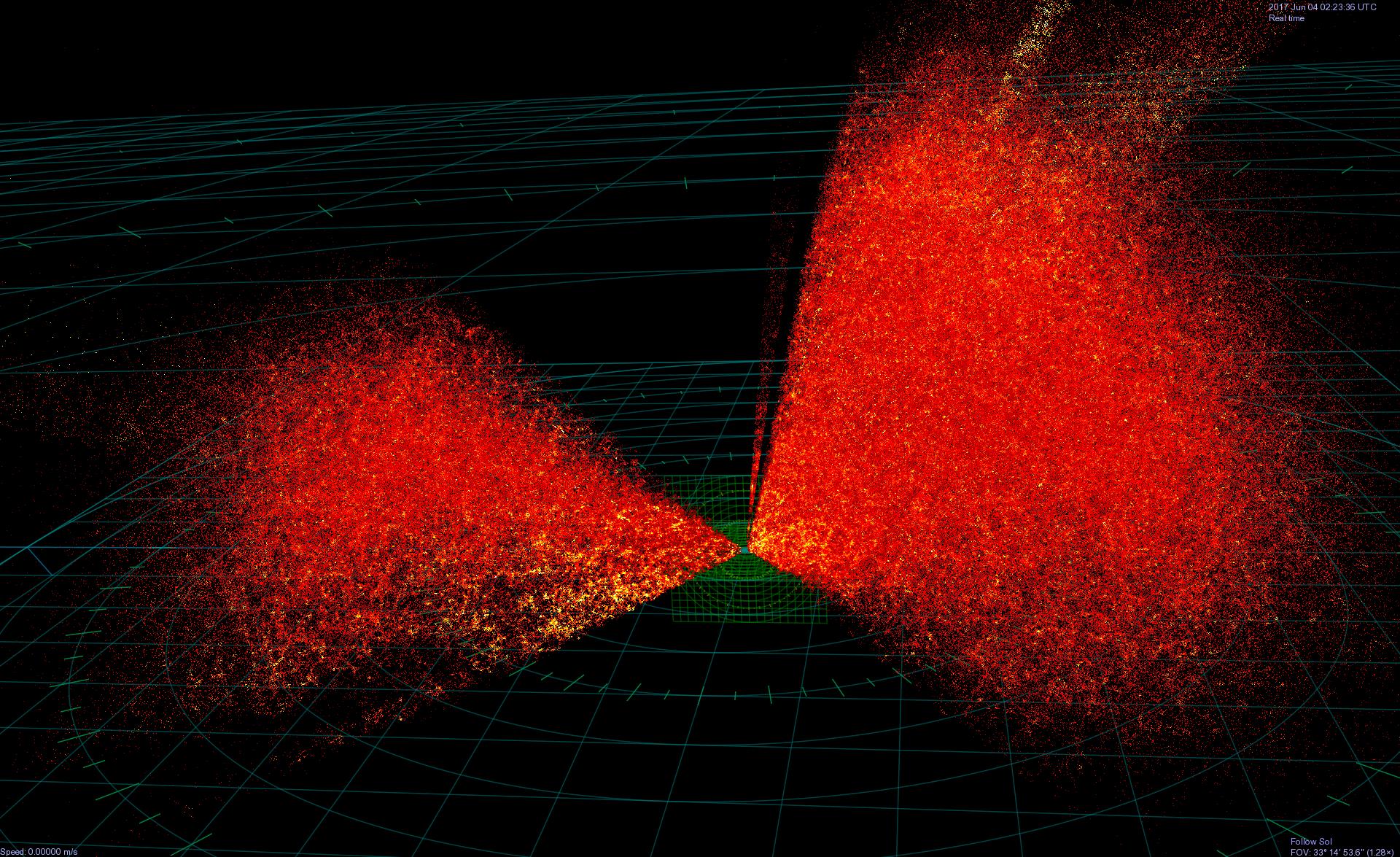


These and other views are available in the Addon.


 Open Clusters

gaia_clusters_v2.zip (7.9 MB, expands to 10.3 MB, 14Jun17)

This Addon for Celestia v1.6.1 displays the positions of stars which are likely to be members of various open clusters. It includes a star database derived from Gaia DR1, defining the locations of 416,945 stars with parallax errors less than 10% of their parallax values. It also includes all-sky plots showing the relative coverage of Tycho-2, TGAS and this Addon's star databases.


Bright Stars

 OB_Stars.zip (404KB, expands to 2.8MB 04May17)

This Addon lets you display the density of the clouds of B stars within about 1500 LY. The colors of the marks vary from red (low density) through yellow (medium density) to white (high density).
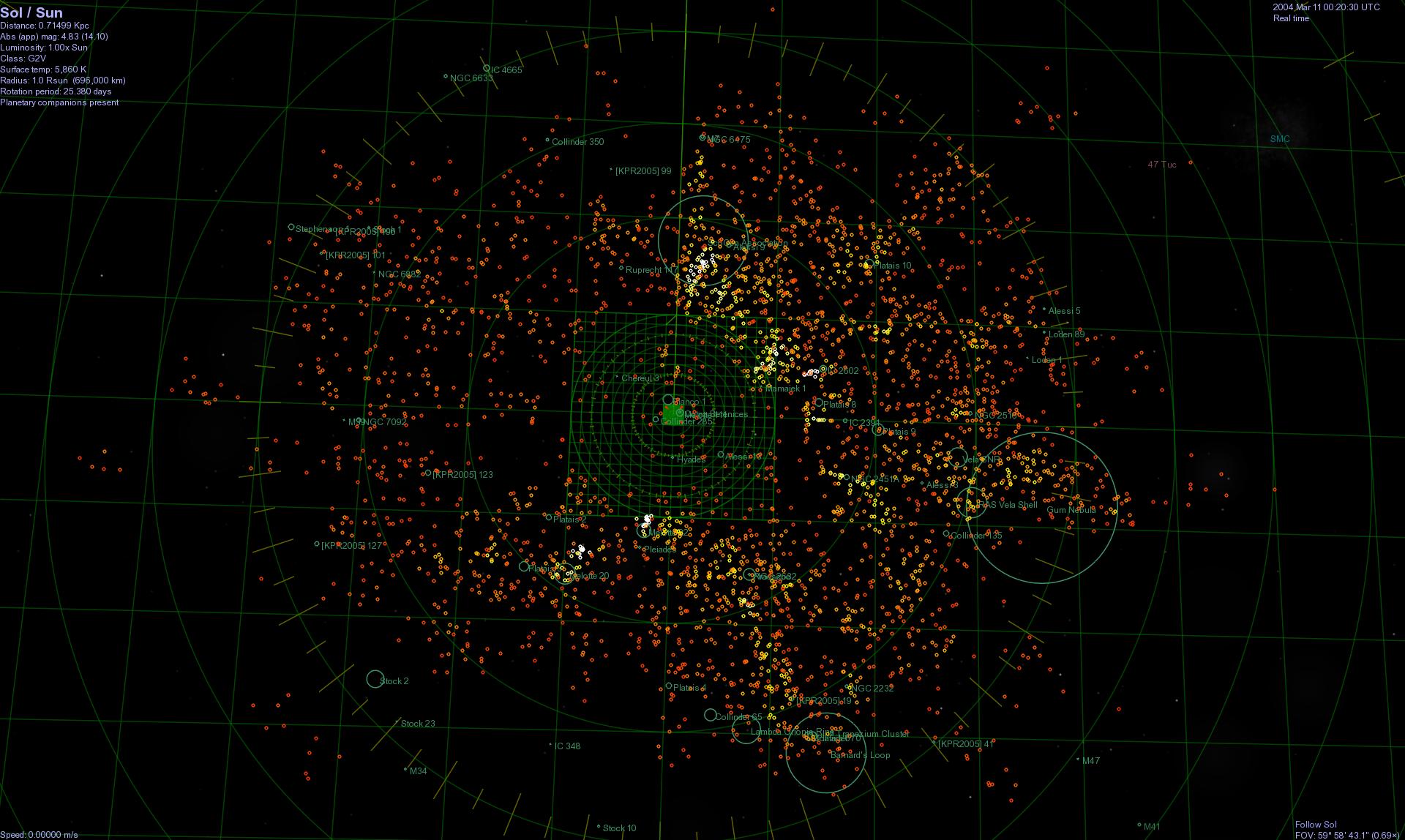

If you squint, you can see a trail of bright marks (high star density) leading from our Sun down to the Orion Nebula, which is at the lower right. Toward the upper right you'll see vast OB Associations of young stars.


Thursday, September 29, 2016

Gaia star catalog for Celestia

The ESA's Gaia astrometric satellite has published its first Data Release, providing RA, Dec and parallax measurements for about 80% of the more than 2 million stars of the Hipparcos Tyco2 catalog. They provide RA and and Dec for another 2 billion or so stars, but they can't be used in Celestia without parallax measurements (distances). An updated DR2 is expected to be available in spring of 2018. For details, see http://sci.esa.int/gaia/

Although a 2 million star database is already available as an Addon for Celestia, most of its distances were derived using spectrographic and magnitude information and not a direct parallax measurement. As a result, they're relatively unreliable.

A revised version of Celestia's default stars.dat, containing about 110,000 stars, is available at https://www.classe.cornell.edu/~seb/celestia/files/gaia_stardb.zip  (about 2.75 MB, expands to  5.4 MB)

Revised versions of Pascal Hartmann's stars.dat containing 1 or 2 million stars are available at https://www.classe.cornell.edu/~seb/celestia/files/gaia_1_2m.zip  (about 51 MB, expands to about 59 MB)

Approximately 2/3 of the stars in each of those three stars.dat files have been updated with Gaia's distance measurements.

Interactive notebook: a WIP

I'm in the process of constructing an interactive notebook for use in Celestia, using Anim8or to design its components. It's interactive in the sense that the viewer can turn its pages, not that new entries can be written from within Celestia. Writing on a page has to be done "out of band" by painting the surface texture for each leaf of the notebook.

A sub-project was to create what looks like a taped-in photograph which will be used in several places. I have made it available on DeviantArt at http://celestiaguru.deviantart.com/art/Photo-03-taped-instant-photo-636917231


Sunday, July 31, 2016

Orion's Arm Wormholes

As another distraction, I've been working on a Celestia Addon which displays the wormhole connections used in the Orion's Arm Universe


Saturday, July 30, 2016

New Celestia Web site and Forum

With permission from Chris Laurel, the official Celestia Web site has been transferred to http://celestiaproject.net/

The new site is being run by a Celestia enthusiast in Russia and includes a Web Forum at http://celestiaproject.net/forum/

Monday, July 11, 2016

Algae and Fish Farming

Production of basic foods in space require plenty of sunlight as well as some gravity. While the plants and animals might not mind microgravity, production facilities work better when there's something pulling the product in particular directions. The toruses counter-rotate in order to minimize torques on the docking facilities.


Monday, July 4, 2016

ECS-5 Norway at Pell

Using Troutweaver's models, I've created a very preliminary and incomplete animation of the warship ECS-5 Norway entering the Pell system. It's about 98 seconds long. The original video is 1024x768.  By default, Youtube shows it at a much lower resolution, but if your browser has a video downloader plugin, you can download it at its full size.

 The video can be seen at
ECS-5 Norway at Pell (on Youtube)

 Here's a teaser screengrab: